In urban kitchens worldwide, a quiet revolution is taking place inside transparent containers. These unassuming vessels, often placed on countertops or balconies, showcase the remarkable transformation of food scraps into nutrient-rich compost through a process that combines ancient decomposition principles with modern ecological awareness. The compost "ecosphere" concept turns waste management into a visible, educational, and almost meditative practice.
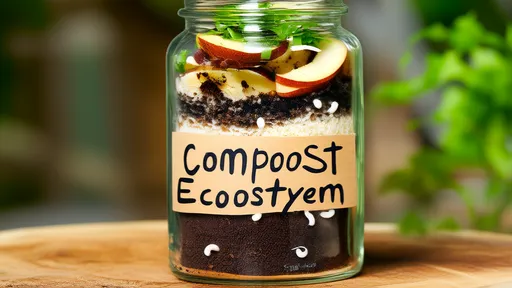
The typical setup involves a clear glass or plastic container layered with soil, shredded newspaper, and food waste, creating a self-contained ecosystem where microorganisms break down organic matter. Unlike traditional composting hidden in backyard bins, these transparent systems allow observers to witness every stage of decomposition – from the initial breakdown by bacteria to the final humification process where complex organic compounds transform into stable soil amendments.
What makes these ecospheres particularly fascinating is their ability to demonstrate nature's circular economy on a miniature scale. Coffee grounds and banana peels don't simply disappear; they become habitats for decomposers and eventually transform into material that could grow new plants. The visual evidence challenges our throwaway culture by making the consequences of food waste – and its potential value – impossible to ignore.
Urban dwellers report that maintaining these systems creates a profound shift in their relationship with food. Seeing orange peels gradually break down over weeks makes people more conscious about portion sizes and food storage. The ecospheres serve as constant reminders that what we consider "garbage" actually contains the building blocks for new life when handled properly.
The science behind these transparent composters reveals why they work so well as educational tools. As food waste decomposes, different microbial communities dominate at various stages, each performing specialized chemical transformations. Early-stage bacteria create visible heat and condensation on the container walls, while later-stage fungi produce intricate white mycelial networks that look like delicate lacework against the glass.
These systems also demonstrate the importance of balanced carbon-to-nitrogen ratios in composting without requiring technical knowledge. When too many nitrogen-rich food scraps overwhelm the carbon sources (like shredded paper or dry leaves), the excess moisture and smell provide immediate visual and olfactory feedback that the mixture needs adjustment.
Beyond individual households, schools and community centers have adopted these transparent composters as teaching tools. Children particularly respond to the hands-on biology lesson, often naming visible decomposer organisms and charting decomposition rates of different materials. Some educators report that students who interact with compost ecospheres show measurable improvements in understanding ecological concepts compared to textbook-only approaches.
The aesthetic dimension shouldn't be underestimated either. Well-maintained compost ecospheres develop striking stratification patterns as materials break down at different rates. The layers – from intact vegetable pieces at the top to nearly finished compost at the bottom – create natural gradients that change daily. Some enthusiasts photograph their systems regularly, creating time-lapse records of the decomposition process that reveal nature's hidden rhythms.
Practical considerations for maintaining these systems involve more than just tossing in food scraps. Successful operators learn to chop materials for faster breakdown, maintain proper moisture levels (often described as "like a wrung-out sponge"), and occasionally aerate the mixture by gently stirring. The transparent containers make monitoring these factors intuitive – condensation patterns indicate moisture levels, while color changes signal progression through decomposition stages.
Critically, these systems demonstrate that effective composting doesn't require large spaces or special equipment. Apartment dwellers in high-rise buildings can process their food waste as efficiently as rural homesteaders, provided they manage scale appropriately. The visibility factor actually improves success rates compared to opaque containers because problems like overwatering or imbalance become obvious before they cause failures.
The psychological impact of these visible decomposition systems may be their most significant contribution to environmentalism. In a culture that typically hides waste management infrastructure, making the process transparent – literally and figuratively – fosters a sense of personal responsibility and connection to natural cycles. Users frequently describe developing what they call "composter's eyes," seeing all organic matter in terms of its potential return to the soil rather than its journey to the landfill.
As cities worldwide grapple with organic waste management challenges, these transparent composting systems offer more than just a diversion solution. They provide a philosophical framework for reconsidering humanity's relationship with consumption and waste. Each glass container becomes a microcosm demonstrating that the linear "take-make-dispose" model contradicts nature's circular wisdom – and that change can begin with something as simple as watching banana peels turn back into earth.

By /Aug 7, 2025

By /Aug 7, 2025

By /Aug 7, 2025
By /Aug 7, 2025

By /Aug 7, 2025

By /Aug 18, 2025

By /Aug 7, 2025

By /Aug 7, 2025

By /Aug 7, 2025

By /Aug 7, 2025

By /Aug 18, 2025

By /Aug 18, 2025

By /Aug 7, 2025

By /Aug 18, 2025

By /Aug 7, 2025

By /Aug 18, 2025

By /Aug 7, 2025

By /Aug 7, 2025

By /Aug 7, 2025

By /Aug 7, 2025