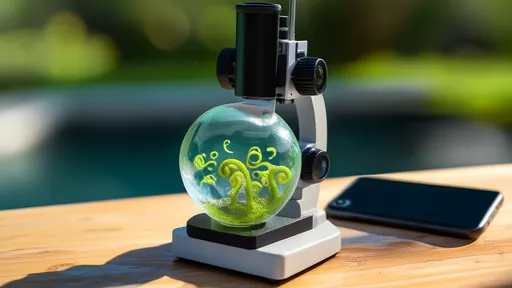
In an era where high-end microscopes remain prohibitively expensive for many citizen scientists and students, an ingenious low-cost solution has emerged from the maker community. The 20 Yuan DIY Smartphone Microscope Project is revolutionizing how we explore microscopic worlds, particularly the vibrant ecosystems hidden in pond water.
The concept builds upon a simple but brilliant premise - transforming ordinary smartphones into powerful microscopic observation tools. While commercial phone microscope attachments exist, this grassroots initiative proves you don't need specialized equipment to peer into the invisible universe of protozoa, algae, and other microorganisms thriving in local water sources.
At the heart of the project lies a clever optical hack. By carefully positioning a glass bead or tiny lens salvaged from old laser pointers or DVD drives just millimeters above a smartphone camera, users achieve magnification levels between 40x to 200x. This surprisingly effective configuration, when combined with proper lighting techniques, reveals details comparable to educational-grade laboratory microscopes.
Building the device requires more patience than technical skill. The most popular version uses a repurposed pill bottle or PVC pipe segment as the body. After cutting an observation window and creating adjustable focus mechanisms with rubber bands or threaded inserts, makers mount their smartphone securely above the lens using improvised clamps. Total material costs typically fall well below 20 Yuan (about $3 USD), especially when using recycled components.
What makes this project particularly impactful is its accessibility. Unlike traditional microscopy that demands significant investment, the smartphone alternative leverages devices already owned by billions worldwide. In developing regions where schools lack science equipment, teachers report students gathering around a single modified phone to witness their first paramecium or diatom.
The pond water exploration aspect has captured imaginations globally. Even urban dwellers can find diverse microbial life in park fountains or neglected puddles. When project participants share their discoveries online, the results often astonish - darting euglenas with their whip-like flagella, rotifers resembling microscopic combine harvesters, and the mesmerizing fractal patterns of algal colonies.
Educational benefits extend beyond biology. The construction process introduces fundamental optics principles, while documentation encourages scientific communication skills. Many enthusiasts progress from simple observation to systematic recording, creating digital field guides of local microorganisms or monitoring water quality through indicator species.
Surprisingly, these DIY microscopes have contributed to professional research. Citizen scientists using the devices have identified rare microbial species in their areas, with some discoveries being verified by academic institutions. The project's creator notes that distributed observation networks could help track environmental changes or emerging biological threats through crowd-sourced data.
Technical limitations exist, of course. The shallow depth of field makes tracking fast-moving organisms challenging, and image resolution depends heavily on the smartphone's camera quality. However, creative solutions continue emerging from the community - from smartphone camera app settings that enhance contrast to simple darkfield illumination techniques using LED lights and parchment paper.
Workshops teaching the build process have sprung up worldwide, often evolving to incorporate local materials. In coastal regions, some use salvaged fishing floats as microscope bodies, while others in tech hubs experiment with 3D-printed modular designs. This cultural adaptation makes the project particularly sustainable and relevant across diverse communities.
The movement has begun influencing mainstream education. Several school districts have adopted the DIY microscope as a standard activity in life science curricula, noting how hands-on construction deepens students' understanding compared to prefabricated equipment. Some universities even include modified versions in their outreach programs to demystify scientific instrumentation.
For amateur naturalists, the implications are profound. Where microscopy once required expensive gear and technical training, now anyone with curiosity and basic crafting skills can explore freshwater microhabitats. Online forums buzz with identification requests and technique exchanges, forming a new kind of grassroots scientific community.
Environmental monitoring represents another promising application. Community groups have begun using standardized DIY microscope protocols to document changes in local water sources. The approach shows particular promise for tracking algal blooms or pollution impacts in areas without access to laboratory facilities.
As smartphone cameras continue improving, so do the capabilities of these homemade instruments. Recent experiments with multi-lens arrays and computational photography techniques suggest the 20 Yuan microscope may soon rival devices costing hundreds of times more. Yet the project's ethos remains firmly rooted in accessibility and empowerment.
The most remarkable outcome isn't technical but cultural. By making microscopic exploration almost universally accessible, the initiative has rekindled wonder about the natural world at microscopic scales. Children who once saw science as distant and institutional now experience discovery firsthand, often in their own backyards.
Future developments may include open-source apps optimized for microbial observation and community-driven microorganism databases. Some visionaries imagine networks of DIY microscopes contributing to global biodiversity mapping or early warning systems for waterborne pathogens.
For now, the project stands as a testament to human ingenuity and our enduring fascination with the unseen. As one young participant marveled while watching a water bear crawl across her smartphone screen: "I never knew our pond was a whole universe." In that moment, the true value of this 20 Yuan revolution becomes clear - not just in cost savings, but in doors opened to scientific wonder.

By /Aug 7, 2025
By /Aug 7, 2025
By /Aug 7, 2025
By /Aug 7, 2025

By /Aug 7, 2025

By /Aug 18, 2025
By /Aug 7, 2025

By /Aug 7, 2025

By /Aug 7, 2025

By /Aug 7, 2025

By /Aug 18, 2025
By /Aug 18, 2025

By /Aug 7, 2025

By /Aug 18, 2025

By /Aug 7, 2025

By /Aug 18, 2025

By /Aug 7, 2025

By /Aug 7, 2025

By /Aug 7, 2025
By /Aug 7, 2025